.
CHEP 2010
International Conference on Computing in High Energy and Nuclear Physics 2010 (CHEP 2010)
Academia Sinica, Taipei, Taiwan
October 18 - 22, 2010
Website: http://event.twgrid.org/chep2010/
Dear colleagues and friends:
We are pleased to announce that the CHEP 2010 will be held at Academia Sinica, Taiwan on 18-22 October 2010. We cordially invite you to submit abstract via online submission system at http://event.twgrid.org/chep2010/cfp.html.
In addition, we are happy to announce an offer from the ACEOLE project to support students having problem to finance their CHEP 2010 attendance and more detailed information will be announced on the next bulletin on May. Detailed Conference information is available at http://event.twgrid.org/chep2010/index.html
Should you have any questions, please feel free to contact us! We are looking forward to seeing you at CHEP 2010, Taipei, Taiwan!
Sincerely yours,
Angelina Shen
CHEP 2010 Secretariat
Tuesday, April 27, 2010


APIO 2010: Asia-Pacific Informatics Olympiad
.
Link to this blog post: http://raffysaldana.blogspot.com/2010/04/apio-2010-asia-pacific-informatics.html
2010 ASIA-PACIFIC INFORMATICS OLYMPIAD
(APIO 2010)
May 8, 2010
Website: http://www.apio2010.org
The Asia-Pacific Informatics Olympiad (APIO) is a new (International Olympiad on Informatics) IOI-like competition for delegations within the South Asian / Western Pacific region. The contest will be held online, with students competiting at contest sites within their own country or area.
APIO'2010 is sponsored by China Computer Federation (CCF), and will be held on 8th May, 2010.
The APIO is open to all high school students (including those who have recently graduated from high school in 2010 but have not entered college).
For prospective participants from the Philippines, contact:
Dr. Rafael P. Saldaña
Organizer
Philippine Delegation
APIO 2010
Tel./Fax.: +63 2 426-6125
Mobile: +63 928 5043121
E-mail: RSALDANA@ateneo.edu
.
Link to this blog post: http://raffysaldana.blogspot.com/2010/04/apio-2010-asia-pacific-informatics.html
2010 ASIA-PACIFIC INFORMATICS OLYMPIAD
(APIO 2010)
May 8, 2010
Website: http://www.apio2010.org
The Asia-Pacific Informatics Olympiad (APIO) is a new (International Olympiad on Informatics) IOI-like competition for delegations within the South Asian / Western Pacific region. The contest will be held online, with students competiting at contest sites within their own country or area.
APIO'2010 is sponsored by China Computer Federation (CCF), and will be held on 8th May, 2010.
The APIO is open to all high school students (including those who have recently graduated from high school in 2010 but have not entered college).
For prospective participants from the Philippines, contact:
Dr. Rafael P. Saldaña
Organizer
Philippine Delegation
APIO 2010
Tel./Fax.: +63 2 426-6125
Mobile: +63 928 5043121
E-mail: RSALDANA@ateneo.edu
.
Thursday, March 18, 2010
ICT For Development: Notes on Poverty and Poverty Alleviation in the Philippines
.
Link to blogpost: http://raffysaldana.blogspot.com/2010/03/ict-for-development-notes-on-poverty.html
Note: I am currently involved in a project dealing with poverty reduction in one of the poorest regions of the world.
Starting today (March 19, 2010) I would like to write a series on "Poverty and Poverty Alleviation in the Philippines"
Part I. Notes on Poverty in the Philippines
Source: Poverty in the Philippines: Causes, Constraints, and Opportunities by the Asian Development Bank 2009
"Poverty and inequality have been recurrent challenges in the Philippines and have again come to the fore in the wake of the current global financial crisis and rising food, fuel, and commodity prices experiend in 2008."
Current Profile of Poverty in the Country
------------------------------------------------
* Poverty incidence among households increased from 24.4% in 2003 to 26.9% in 2006
* The number of poor families (households) increased from 4.0 million in 2003 to 4.7 million in 2006.
* The headcount index increased from 30.0% in 2003 to 32.9% in 2006
* The number of poor people increased from 23.8 million in 2003 to 27.6 million in 2006.
* According to the 2006 poverty data, Mindanao has the highest poverty incidence at 38.8% but Luzon has the highest number of poor families, with almost 2 million families (42.4% of the total).
* Self-rated poverty has ranged from 50% to 52% for most of the 2008, peaking at 59% (an estimated 10.6 million people) in the second quarter.
*Inequality has also been persistent over the years. Although the Gini coefficient improved to 0.4580 in 2006 from 0.4605 in 2003 and 0.4872 in 2000, the level of inequality remains hign compared with other countries in Asia has hardly changed for more tha 20 years.
*High inequality has limited the impact of economic growth on proverty reduction.
To be continued ...
Dr. Rafael P. Saldaña
Consultant on Evolutionary Trade, Agent-Based Modeling and Grid Computing
Asian Development Bank (ADB)
Associate Professor
Applied Mathematics and Computational Science
Mathematics Department
School of Science and Engineering
Ateneo de Manila University
Tel./Fax.: +63-2-4266125
Mobile: +63 928 5043121
E-mails: RSALDANA@ateneo.edu, RAFFYSALDANA@gmail.com
Blog: http://raffysaldana.blogspot.com/
19 March 2010
.
Link to blogpost: http://raffysaldana.blogspot.com/2010/03/ict-for-development-notes-on-poverty.html
Note: I am currently involved in a project dealing with poverty reduction in one of the poorest regions of the world.
Starting today (March 19, 2010) I would like to write a series on "Poverty and Poverty Alleviation in the Philippines"
Part I. Notes on Poverty in the Philippines
Source: Poverty in the Philippines: Causes, Constraints, and Opportunities by the Asian Development Bank 2009
"Poverty and inequality have been recurrent challenges in the Philippines and have again come to the fore in the wake of the current global financial crisis and rising food, fuel, and commodity prices experiend in 2008."
Current Profile of Poverty in the Country
------------------------------------------------
* Poverty incidence among households increased from 24.4% in 2003 to 26.9% in 2006
* The number of poor families (households) increased from 4.0 million in 2003 to 4.7 million in 2006.
* The headcount index increased from 30.0% in 2003 to 32.9% in 2006
* The number of poor people increased from 23.8 million in 2003 to 27.6 million in 2006.
* According to the 2006 poverty data, Mindanao has the highest poverty incidence at 38.8% but Luzon has the highest number of poor families, with almost 2 million families (42.4% of the total).
* Self-rated poverty has ranged from 50% to 52% for most of the 2008, peaking at 59% (an estimated 10.6 million people) in the second quarter.
*Inequality has also been persistent over the years. Although the Gini coefficient improved to 0.4580 in 2006 from 0.4605 in 2003 and 0.4872 in 2000, the level of inequality remains hign compared with other countries in Asia has hardly changed for more tha 20 years.
*High inequality has limited the impact of economic growth on proverty reduction.
To be continued ...
Dr. Rafael P. Saldaña
Consultant on Evolutionary Trade, Agent-Based Modeling and Grid Computing
Asian Development Bank (ADB)
Associate Professor
Applied Mathematics and Computational Science
Mathematics Department
School of Science and Engineering
Ateneo de Manila University
Tel./Fax.: +63-2-4266125
Mobile: +63 928 5043121
E-mails: RSALDANA@ateneo.edu, RAFFYSALDANA@gmail.com
Blog: http://raffysaldana.blogspot.com/
19 March 2010
.
2010 Summer Computer Simulation Conference (Canada)
.
Link to blog post: http://raffysaldana.blogspot.com/2010/03/2010-summer-computer-simulation.html
2010 Summer Computer Simulation Conference (SCSC'10)
11-14 July 2010
Ottawa, Ontario, Canada
CALL FOR PAPERS
(DEADLINE QUICKLY APPROACHING - MARCH 22nd)
http://www.dacya.ucm.es/jlrisco/SCSC10/
http://simulation.ning.com/
Organized by the Society for Modeling and Simulation International
Co-Sponsored by ACM SIGSIM (pending)
Come to Ottawa, Canada for SCSC 2010 to the 42nd edition of this leading conference in the field of Modeling and Simulation. SCSC’10 is focused on basic and applied research in Modeling and Simulation, a critical area for supporting Research and Development as well as competitiveness worldwide.SCSC provides an International Forum for presenting the State of the Art to the International Simulation Community as well as the Effectiveness of Simulation Experiences in World Businesses.
The purpose of the conference is to provide a forum for academic researchers, governmental and industrial investigators and practitioners to exchange ideas and discuss developments in this growing field.SCSC 2010 features varied tutorials, tracks and workshops. The conferencefocuses on modeling and simulation, tools, theory, methodologies andapplications, providing a forum the latest R&D results in academia andindustry.In parallel with technical presentations, companies and research groups willbe exhibiting their most advanced products.All submissions will be reviewed based on the draft full paper and/orextended abstract. The best contributed paper will be given a Best PaperAward. A selected group of full papers will be invited for a Special Issue Proposal of the Simulation Journal (SCS). All papers will be publishedin the ACM Digital Library.
Organizing Committee:
Gabriel Wainer, Carleton University, Canada (General Chair)
Mhamed Itmi, INSA Rouen, France
Peter Kropf, Université de Neuchâtel, Switzerland
Andreas Tolk, VMASC, USA
Further information:
http://www.dacya.ucm.es/jlrisco/SCSC10/
.
Or on the new Network on Modeling and Simulation Studies: http://simulation.ning.com/
Link to blog post: http://raffysaldana.blogspot.com/2010/03/2010-summer-computer-simulation.html
2010 Summer Computer Simulation Conference (SCSC'10)
11-14 July 2010
Ottawa, Ontario, Canada
CALL FOR PAPERS
(DEADLINE QUICKLY APPROACHING - MARCH 22nd)
http://www.dacya.ucm.es/jlrisco/SCSC10/
http://simulation.ning.com/
Organized by the Society for Modeling and Simulation International
Co-Sponsored by ACM SIGSIM (pending)
Come to Ottawa, Canada for SCSC 2010 to the 42nd edition of this leading conference in the field of Modeling and Simulation. SCSC’10 is focused on basic and applied research in Modeling and Simulation, a critical area for supporting Research and Development as well as competitiveness worldwide.SCSC provides an International Forum for presenting the State of the Art to the International Simulation Community as well as the Effectiveness of Simulation Experiences in World Businesses.
The purpose of the conference is to provide a forum for academic researchers, governmental and industrial investigators and practitioners to exchange ideas and discuss developments in this growing field.SCSC 2010 features varied tutorials, tracks and workshops. The conferencefocuses on modeling and simulation, tools, theory, methodologies andapplications, providing a forum the latest R&D results in academia andindustry.In parallel with technical presentations, companies and research groups willbe exhibiting their most advanced products.All submissions will be reviewed based on the draft full paper and/orextended abstract. The best contributed paper will be given a Best PaperAward. A selected group of full papers will be invited for a Special Issue Proposal of the Simulation Journal (SCS). All papers will be publishedin the ACM Digital Library.
Organizing Committee:
Gabriel Wainer, Carleton University, Canada (General Chair)
Mhamed Itmi, INSA Rouen, France
Peter Kropf, Université de Neuchâtel, Switzerland
Andreas Tolk, VMASC, USA
Further information:
http://www.dacya.ucm.es/jlrisco/SCSC10/
.
Or on the new Network on Modeling and Simulation Studies: http://simulation.ning.com/
Tuesday, March 16, 2010
ITCS 2010 (Cebu, Philippines)
.
ITCS 2010 Call for Papers
Submission Deadline extended to March 30, 2010 (Final hard extension)
===========================================================
The 2nd International Conference on
Information Technology Convergence and Services (ITCS 2010)
===========================================================
http://www.ftrai.org/itcs2010/
Cebu, Philippines, August 11-13, 2010
----------------------------------------------------------------------------------------------
**Distinguished papers accepted and presented in ITCS 2010, after further revisions, will be published in the special issues of the following international journals:
- The Journal of Supercomputing (JoS) - Springer (SCI)
http://www.springer.com/computer/programming/journal/11227
- Multimedia tools and applications (MTAP) - Springer (SCIE)
http://www.springer.com/computer/information+systems/journal/11042
- Information - International Information Institute (SCIE)
http://www.information-iii.org/info/index.html
- International Journal of Information Technology, Communications and Convergence (IJITCC) - Inderscience
http://www.inderscience.com/browse/index.php?journalCODE=ijitcc
In addition, good papers from Korea authors will be recommended to international journals indexed by KCI-E in NRF-K.
- Journal of Information Processing Systems (JIPS)
http://jips.kips.or.kr/
================================================================================================
The 2nd International Conference on Information Technology Convergence and Services (ITCS 2010) will be held in Cebu, Philippines on August 11-13, 2010.
The ITCS 2010 will be the most comprehensive conference focused on the various aspects of advances in information technology convergence, applications, and services. The ITCS 2010 will provide an opportunity for academic and industry professionals to discuss the latest issues and progress in the area of ITCS.
In addition, the conference will publish high quality papers which are closely related to the various theories, modeling, and practical applications in ITCS. Furthermore, we expect that the conference and its publications will be a trigger for further related research and technology improvements in this important subject.
The ITCS 2010 is the next event in a series of highly successful international symposium on IT and its Applications (ITA-09), previously held in Jeju, Korea on December 10 - 12, 2009.
Topics (9 Tracks)
-------------------
1.Advanced Computational Science and Applications
- Algorithms and data structures
- Programming languages and compilers
- Concurrent, parallel, and distributed systems
- Software engineering
- Computer architecture and theory of computation
- Communications, Cryptography and Security
- Database and Date mining
- Artificial intelligence
- Computer graphics and Games
2.Advanced Electrical and Electronics Engineering and Technology
- Electronics
- Sensors
- Electronic Displays
- Microwave and Millimeter Wave Technologies
- Electromagnetic Theory
- Physical Design
- Neural Control, Fuzzy Control, Genetic Control
- Industrial Control, Control for Electric Machines
- Robotic Networks, Mechatronics
- Electronics for Control, Electrical and Electronic Measurement
- Telecommunication Systems
- Communication Electronics
- Military Communications
- Wireless and Mobile Computing
- Other Applications
3.Intelligent Manufacturing Technology and Services
- Computer integrated manufacturing
- Agile manufacturing
- Flexible manufacturing systems
- Virtual manufacturing
- Business process re-engineering for manufacturing
- Multi-sensory systems
- knowledge engineering based systems
- Manufacturing systems
- Foundations of service science, theory, complexity, modeling
- Service computing, cloud/utility/Web computing, SOA
- Service oriented process integration and management
- Service design and planning
- Service quality and operation management
- Service oriented enterprise information systems
- Integration of SOA and Web Service and its applications
- Service mining in marketing, customer relationship management, business intelligence
4.Advanced Management Information Systems and Services
- Strategic Use of Information Resource
- Organization Impacts of Information Systems Use
- Information Technology and the Design of Work
- Information Technology and Changing Business Processes
- Using Information Ethically
- Management Information Systems Organization
- Funding IT
- Knowledge Management
5.Electronic Commerce, Business and Management
- e-Business Strategy and Behavioral Issues
- e-Business Evaluation
- B2B e-Business Impacts
- e-Commerce
- e-Security
- Electronic Marketplace & Economics
- Business Value of e-Business
- Econometric Models of e-Commerce Development
- Global e-Commerce Diffusion
- e-Marketing
- Mobile business
- e-Health
- e-Government
- Tourism e-Business
- e-Business Policies & Regulation
- e-Business Applications
- Business Collaboration & e-Services
6.Intelligent Vehicular Systems and Communications
- Interworking with sensor network technologies for IVC
- Multimedia content distribution for IVC
- Network architecture and protocol for IVC (Intelligent Vehicular Communication)
- Scalability issues for IVC
- Security and privacy issues for IVC
- Traffic and flow control issues for IVC
- User interfaces for IVC
- Vehicular network management for IVC
- Vehicular wireless communications applications and services for IVC
- Vehicular telematics based on emerging wireless technologies for IVC
7.Bio-inspired Computing and Applications
- Neural networks
- Evolutionary computing and genetic algorithms
- DNA and molecular computing (including wet-lab results)
- Membrane computing
- Biological computing
- Swarm intelligence
- Autonomy-oriented computing
- Cellular and molecular automata
- Bioinformatics and cheminformatics
- Computational biology and drug design
- Systems biology and synthetic biology
- Computational genomics and proteomics
- Computational neuroscience
- Artificial life and artificial immune systems
- Biological implementation and molecular implementation
- DNA nanotechnology
8.Advanced IT Bio/Medical Engineering
- Biomedical imaging, image processing & visualization
- Bioelectrical and neural engineering
- Biomaterials and biomedical optics
- Biomechanics and bio-transport
- Methods and biology effects of NMR/CT/ECG technology
- Biomedical devices, sensors, and artificial organs
- Biochemical, cellular, molecular and tissue engineering
- Biomedical robotics and mechanics
- Rehabilitation engineering and clinical engineering
- Health monitoring systems and wearable system
- Bio-signal processing and analysis
- Biometric and bio-measurement
- Bioinformatics and Computational Biology
- Health Care Technology
- Ethical Issues Associated with Medical Technology
9.Modeling and Services for Intelligent Building, Town, and City
- Intelligent Building, Town, and City Facility Management
- Intelligent Building, Town, and City System
- Advanced HVAC Systems
- Advanced Energy Conversion Systems
- Application of Air Pollution Modeling and Control
- Architectural Acoustics and Audio Systems
- Computational Methods in Building Environment Design
- Energy Management in Buildings
- Facilities and Quality Management
- Indoor Air Quality Technology and Management
- Materials in Built Environment
- Occupational Safety and Health Issues in Buildings
- Risk Management and Decision-Making in Intelligent Building
- Vibrations and Mechanical Signature Analysis
- Electrical Facilities in Intelligent Buildings
- Intelligent Building Automation and Control Systems
- Financial Assessment of Intelligent Building Systems
Organization
-------------------
==Honorary Chair==
Jaime Caro, CSP President, University of the Philippines-Dilliman
==Steering Chair==
Jong Hyuk Park, Seoul National University of Technology, Korea
==General Chairs==
Sang-Soo Yeo, Mokwon University, Korea
Andrew Kusiak, MIE Department, The University of Iowa, Iowa City, USA
Alan Chin-Chen Chang, National Chung Cheng University, Taiwan
==Program Chairs==
Changhoon Lee, Hanshin University, Korea
Justin Zhan, CMU, USA
Naveen Chilamkurti, La Trobe University, Australia
== Workshop/Special Session Chairs ==
Young-Sik Jeong, Wonkwang University, Korea
Bernady O. Apduhan, Kyushu Sangyo University, Japan
==International Advisory Board Committee==
Hamid R. Arabnia, University of Georgia, USA
Han-Chieh Chao, National Ilan University, TAIWAN, ROC
Hsiao-Hwa Chen, National Sun Yat-Sen University, TAIWAN, ROC
Mohammad S. Obaidat, Monmouth University, USA
Habib F. Rashvand, University of Warwick, UK
==Local Arrangement Chairs==
Rafael Saldana, Ateneo de Manila University, Philippines
Henry N. Adorna, University of the Philippines, Philippines
Gregg Victor Gabison, University of San Jose Recoletos, Philippines
==Publicity Chairs==
Seng Loke, La Trobe University, Melbourne, Australia
Der-Jiunn Deng, National Changhua University of Education, Taiwan
Soo-Kyun Kim Paichai University KOREA
Binod Vaidya, Inst. of Telecom./Univ. of Beira Interior, Portugal
Yan Zhang (Simula Research Laboratory, Norway
Wenbin Jiang, Huazhong University of Science & Technology, China
==Finance & Registration Chairs==
Yang Sun Lee, Chosun University, Korea
Hang-Bae Chang, Daejin University, Korea
==Program Committee==
http://www.ftrai.org/itcs2010/committee1.php
Important Dates
-----------------
Paper Submission Deadline: March 30, 2010 (Final Extension)
Acceptance Notification: April 20, 2010
Camera Ready Due: April 30, 2010
Conference Dates: August 11 - 13, 2010
Paper Submission and Publication
---------------------------------
There will be a combination of presentations including scientific papers. Prospective authors are invited, in the first instance to submit papers for oral presentation in any of the areas of interest for this conference. Authors should submit papers with 4-6 pagesin length (Max. 8 pages, extra charges for two pages). The Conference proceedings will be published by IEEE Press (IEEE eXpress Conference Publishing group) and all papers will be included in the IEEE Xplore (indexed in EI).
Please use the IEEE Conference proceedings format (US letter size, available for download here: IEEE Manuscript Templates for Conference Proceedings, http://www.ieee.org/web/publications/pubservices/confpub/AuthorTools/conferenceTemplates.html) for submission.
Submission system: http://www.editorialsystem.net/itcs2010/
Special Issues
---------------
Distinguished papers accepted and presented in ITCS 2010, after further revisions, will be published in the special issues of international journals.
- The Journal of Supercomputing (JoS) - Springer (SCI)
http://www.springer.com/computer/programming/journal/11227
- multimedia tools and applications (MTAP) - Springer (SCIE)
http://www.springer.com/computer/information+systems/journal/11042
- Information - International Information Institute (SCIE)
http://www.information-iii.org/info/index.html
- International Journal of Information Technology, Communications and Convergence (IJITCC) - Inderscience
http://www.inderscience.com/browse/index.php?journalCODE=ijitcc
In addition, good papers from Korea authors will be recommended to international journals indexed by KCI-E in NRF-K.
- Journal of Information Processing Systems (JIPS)
http://jips.kips.or.kr/
Contact Information
---------------------
If you have any questions about the CFPs and papers submission,
please email to Prof. Jong Hyuk Park (parkjonghyuk1@hotmail.com) and Prof. Changhoon Lee (itcs.conf@gmail.com, cryptography1@gmail.com).
ITCS 2010 Call for Papers
Submission Deadline extended to March 30, 2010 (Final hard extension)
===========================================================
The 2nd International Conference on
Information Technology Convergence and Services (ITCS 2010)
===========================================================
http://www.ftrai.org/itcs2010/
Cebu, Philippines, August 11-13, 2010
----------------------------------------------------------------------------------------------
**Distinguished papers accepted and presented in ITCS 2010, after further revisions, will be published in the special issues of the following international journals:
- The Journal of Supercomputing (JoS) - Springer (SCI)
http://www.springer.com/computer/programming/journal/11227
- Multimedia tools and applications (MTAP) - Springer (SCIE)
http://www.springer.com/computer/information+systems/journal/11042
- Information - International Information Institute (SCIE)
http://www.information-iii.org/info/index.html
- International Journal of Information Technology, Communications and Convergence (IJITCC) - Inderscience
http://www.inderscience.com/browse/index.php?journalCODE=ijitcc
In addition, good papers from Korea authors will be recommended to international journals indexed by KCI-E in NRF-K.
- Journal of Information Processing Systems (JIPS)
http://jips.kips.or.kr/
================================================================================================
The 2nd International Conference on Information Technology Convergence and Services (ITCS 2010) will be held in Cebu, Philippines on August 11-13, 2010.
The ITCS 2010 will be the most comprehensive conference focused on the various aspects of advances in information technology convergence, applications, and services. The ITCS 2010 will provide an opportunity for academic and industry professionals to discuss the latest issues and progress in the area of ITCS.
In addition, the conference will publish high quality papers which are closely related to the various theories, modeling, and practical applications in ITCS. Furthermore, we expect that the conference and its publications will be a trigger for further related research and technology improvements in this important subject.
The ITCS 2010 is the next event in a series of highly successful international symposium on IT and its Applications (ITA-09), previously held in Jeju, Korea on December 10 - 12, 2009.
Topics (9 Tracks)
-------------------
1.Advanced Computational Science and Applications
- Algorithms and data structures
- Programming languages and compilers
- Concurrent, parallel, and distributed systems
- Software engineering
- Computer architecture and theory of computation
- Communications, Cryptography and Security
- Database and Date mining
- Artificial intelligence
- Computer graphics and Games
2.Advanced Electrical and Electronics Engineering and Technology
- Electronics
- Sensors
- Electronic Displays
- Microwave and Millimeter Wave Technologies
- Electromagnetic Theory
- Physical Design
- Neural Control, Fuzzy Control, Genetic Control
- Industrial Control, Control for Electric Machines
- Robotic Networks, Mechatronics
- Electronics for Control, Electrical and Electronic Measurement
- Telecommunication Systems
- Communication Electronics
- Military Communications
- Wireless and Mobile Computing
- Other Applications
3.Intelligent Manufacturing Technology and Services
- Computer integrated manufacturing
- Agile manufacturing
- Flexible manufacturing systems
- Virtual manufacturing
- Business process re-engineering for manufacturing
- Multi-sensory systems
- knowledge engineering based systems
- Manufacturing systems
- Foundations of service science, theory, complexity, modeling
- Service computing, cloud/utility/Web computing, SOA
- Service oriented process integration and management
- Service design and planning
- Service quality and operation management
- Service oriented enterprise information systems
- Integration of SOA and Web Service and its applications
- Service mining in marketing, customer relationship management, business intelligence
4.Advanced Management Information Systems and Services
- Strategic Use of Information Resource
- Organization Impacts of Information Systems Use
- Information Technology and the Design of Work
- Information Technology and Changing Business Processes
- Using Information Ethically
- Management Information Systems Organization
- Funding IT
- Knowledge Management
5.Electronic Commerce, Business and Management
- e-Business Strategy and Behavioral Issues
- e-Business Evaluation
- B2B e-Business Impacts
- e-Commerce
- e-Security
- Electronic Marketplace & Economics
- Business Value of e-Business
- Econometric Models of e-Commerce Development
- Global e-Commerce Diffusion
- e-Marketing
- Mobile business
- e-Health
- e-Government
- Tourism e-Business
- e-Business Policies & Regulation
- e-Business Applications
- Business Collaboration & e-Services
6.Intelligent Vehicular Systems and Communications
- Interworking with sensor network technologies for IVC
- Multimedia content distribution for IVC
- Network architecture and protocol for IVC (Intelligent Vehicular Communication)
- Scalability issues for IVC
- Security and privacy issues for IVC
- Traffic and flow control issues for IVC
- User interfaces for IVC
- Vehicular network management for IVC
- Vehicular wireless communications applications and services for IVC
- Vehicular telematics based on emerging wireless technologies for IVC
7.Bio-inspired Computing and Applications
- Neural networks
- Evolutionary computing and genetic algorithms
- DNA and molecular computing (including wet-lab results)
- Membrane computing
- Biological computing
- Swarm intelligence
- Autonomy-oriented computing
- Cellular and molecular automata
- Bioinformatics and cheminformatics
- Computational biology and drug design
- Systems biology and synthetic biology
- Computational genomics and proteomics
- Computational neuroscience
- Artificial life and artificial immune systems
- Biological implementation and molecular implementation
- DNA nanotechnology
8.Advanced IT Bio/Medical Engineering
- Biomedical imaging, image processing & visualization
- Bioelectrical and neural engineering
- Biomaterials and biomedical optics
- Biomechanics and bio-transport
- Methods and biology effects of NMR/CT/ECG technology
- Biomedical devices, sensors, and artificial organs
- Biochemical, cellular, molecular and tissue engineering
- Biomedical robotics and mechanics
- Rehabilitation engineering and clinical engineering
- Health monitoring systems and wearable system
- Bio-signal processing and analysis
- Biometric and bio-measurement
- Bioinformatics and Computational Biology
- Health Care Technology
- Ethical Issues Associated with Medical Technology
9.Modeling and Services for Intelligent Building, Town, and City
- Intelligent Building, Town, and City Facility Management
- Intelligent Building, Town, and City System
- Advanced HVAC Systems
- Advanced Energy Conversion Systems
- Application of Air Pollution Modeling and Control
- Architectural Acoustics and Audio Systems
- Computational Methods in Building Environment Design
- Energy Management in Buildings
- Facilities and Quality Management
- Indoor Air Quality Technology and Management
- Materials in Built Environment
- Occupational Safety and Health Issues in Buildings
- Risk Management and Decision-Making in Intelligent Building
- Vibrations and Mechanical Signature Analysis
- Electrical Facilities in Intelligent Buildings
- Intelligent Building Automation and Control Systems
- Financial Assessment of Intelligent Building Systems
Organization
-------------------
==Honorary Chair==
Jaime Caro, CSP President, University of the Philippines-Dilliman
==Steering Chair==
Jong Hyuk Park, Seoul National University of Technology, Korea
==General Chairs==
Sang-Soo Yeo, Mokwon University, Korea
Andrew Kusiak, MIE Department, The University of Iowa, Iowa City, USA
Alan Chin-Chen Chang, National Chung Cheng University, Taiwan
==Program Chairs==
Changhoon Lee, Hanshin University, Korea
Justin Zhan, CMU, USA
Naveen Chilamkurti, La Trobe University, Australia
== Workshop/Special Session Chairs ==
Young-Sik Jeong, Wonkwang University, Korea
Bernady O. Apduhan, Kyushu Sangyo University, Japan
==International Advisory Board Committee==
Hamid R. Arabnia, University of Georgia, USA
Han-Chieh Chao, National Ilan University, TAIWAN, ROC
Hsiao-Hwa Chen, National Sun Yat-Sen University, TAIWAN, ROC
Mohammad S. Obaidat, Monmouth University, USA
Habib F. Rashvand, University of Warwick, UK
==Local Arrangement Chairs==
Rafael Saldana, Ateneo de Manila University, Philippines
Henry N. Adorna, University of the Philippines, Philippines
Gregg Victor Gabison, University of San Jose Recoletos, Philippines
==Publicity Chairs==
Seng Loke, La Trobe University, Melbourne, Australia
Der-Jiunn Deng, National Changhua University of Education, Taiwan
Soo-Kyun Kim Paichai University KOREA
Binod Vaidya, Inst. of Telecom./Univ. of Beira Interior, Portugal
Yan Zhang (Simula Research Laboratory, Norway
Wenbin Jiang, Huazhong University of Science & Technology, China
==Finance & Registration Chairs==
Yang Sun Lee, Chosun University, Korea
Hang-Bae Chang, Daejin University, Korea
==Program Committee==
http://www.ftrai.org/itcs2010/committee1.php
Important Dates
-----------------
Paper Submission Deadline: March 30, 2010 (Final Extension)
Acceptance Notification: April 20, 2010
Camera Ready Due: April 30, 2010
Conference Dates: August 11 - 13, 2010
Paper Submission and Publication
---------------------------------
There will be a combination of presentations including scientific papers. Prospective authors are invited, in the first instance to submit papers for oral presentation in any of the areas of interest for this conference. Authors should submit papers with 4-6 pagesin length (Max. 8 pages, extra charges for two pages). The Conference proceedings will be published by IEEE Press (IEEE eXpress Conference Publishing group) and all papers will be included in the IEEE Xplore (indexed in EI).
Please use the IEEE Conference proceedings format (US letter size, available for download here: IEEE Manuscript Templates for Conference Proceedings, http://www.ieee.org/web/publications/pubservices/confpub/AuthorTools/conferenceTemplates.html) for submission.
Submission system: http://www.editorialsystem.net/itcs2010/
Special Issues
---------------
Distinguished papers accepted and presented in ITCS 2010, after further revisions, will be published in the special issues of international journals.
- The Journal of Supercomputing (JoS) - Springer (SCI)
http://www.springer.com/computer/programming/journal/11227
- multimedia tools and applications (MTAP) - Springer (SCIE)
http://www.springer.com/computer/information+systems/journal/11042
- Information - International Information Institute (SCIE)
http://www.information-iii.org/info/index.html
- International Journal of Information Technology, Communications and Convergence (IJITCC) - Inderscience
http://www.inderscience.com/browse/index.php?journalCODE=ijitcc
In addition, good papers from Korea authors will be recommended to international journals indexed by KCI-E in NRF-K.
- Journal of Information Processing Systems (JIPS)
http://jips.kips.or.kr/
Contact Information
---------------------
If you have any questions about the CFPs and papers submission,
please email to Prof. Jong Hyuk Park (parkjonghyuk1@hotmail.com) and Prof. Changhoon Lee (itcs.conf@gmail.com, cryptography1@gmail.com).
Sunday, March 14, 2010
Call for Proposals: United Nations' Urban Youth Fund
. UN-HABITAT Urban Youth Fund Youth-led organizations in developing countries working to improve the lives of young people and their communities can now seek financing for their projects through the UN-HABITAT Urban Youth Fund. The Fund will provide grants for innovative projects that promote employment, good governance, shelter and secure tenure. Only applicants aged 15-32 from cities in developing countries can qualify for a grant. Support will be provided primarily for those working to improve slum conditions and to raise opportunities for young people growing up in poverty. Projects encouraging gender equality or involving partnerships with the government or the private sector are particularly welcome. Small development initiatives are eligible for grants of up to USD 5,000, and larger projects up to USD 25,000. For more information, visit the website: http://cambodiajobs.blogspot. . |  |
Program, Day 1, March 15, ICT Asia 2010 (Tokyo, Japan)


.


.
(Note: Click on the image to see a larger view.)
Link to blogpost: http://raffysaldana.blogspot.com/2010/03/program-day-1-ict-asia-2010-tokyo-japan.html
ICT ASIA 2010
March 15 - 16, 2010
Keio University, Tokyo, Japan
PROGRAM OF ACTIVITIES
.
Day 1. March 15, 2010
Saturday, March 13, 2010
ICT Asia 2010 (Keio University, Tokyo, Japan)
.
Link to blogpost: http://raffysaldana.blogspot.com/2010/03/ict-asia-2010-keio-university-tokyo.html
7th ICT Asia regional seminar, ICT Asia program
March 15 and 16, 2010
Keio University, Mita campus, Tokyo, Japan
http://www.keio.ac.jp/index-en.html
Announcement
Taking into account the dynamism of the ICT sector in Asia, a regional program for education
and fundamental and applied research in ICT has been set up through the scientific network
of the French cooperation in this region, along with research bodies and higher education
institutions.
The ICT-Asia program of the French Ministries of Foreign and European Affairs
and of Higher Education and Research was launched in November 2003 in Bangkok at the
first regional seminar held at the Asian Institute of Technology (AIT), which was attended by
more than 70 representatives from France and a dozen countries in the region.
Organized by the Embassy of France in Tokyo and the French Regional Delegation for
Co-operation in South-East Asia, the 7th Regional Conference in the framework of the
ICT-Asia Scheme will be held at the Keio University in Tokyo - Japan, on March 15 &
16, 2010.
This symposium will give the opportunity, inter alia, to follow up on the 5 projects selected
under the fifth call for proposals in 2008 (you are kindly advised to read their descriptions
online at: http://www.ict-asia-france.org/projects/projects) and discuss new avenues for cooperation between France and Asia. It will include a presentation of the scheme, thematic
sessions of scientific presentations and a discussion of the terms of the next call for
proposals. Furthermore, Professor Jun Murai of Keio University, known as "the father of
Japan's Internet" has kindly agreed to host the conference.
.
Link to blogpost: http://raffysaldana.blogspot.com/2010/03/ict-asia-2010-keio-university-tokyo.html
7th ICT Asia regional seminar, ICT Asia program
March 15 and 16, 2010
Keio University, Mita campus, Tokyo, Japan
http://www.keio.ac.jp/index-en.html
Announcement
Taking into account the dynamism of the ICT sector in Asia, a regional program for education
and fundamental and applied research in ICT has been set up through the scientific network
of the French cooperation in this region, along with research bodies and higher education
institutions.
The ICT-Asia program of the French Ministries of Foreign and European Affairs
and of Higher Education and Research was launched in November 2003 in Bangkok at the
first regional seminar held at the Asian Institute of Technology (AIT), which was attended by
more than 70 representatives from France and a dozen countries in the region.
Organized by the Embassy of France in Tokyo and the French Regional Delegation for
Co-operation in South-East Asia, the 7th Regional Conference in the framework of the
ICT-Asia Scheme will be held at the Keio University in Tokyo - Japan, on March 15 &
16, 2010.
This symposium will give the opportunity, inter alia, to follow up on the 5 projects selected
under the fifth call for proposals in 2008 (you are kindly advised to read their descriptions
online at: http://www.ict-asia-france.org/projects/projects) and discuss new avenues for cooperation between France and Asia. It will include a presentation of the scheme, thematic
sessions of scientific presentations and a discussion of the terms of the next call for
proposals. Furthermore, Professor Jun Murai of Keio University, known as "the father of
Japan's Internet" has kindly agreed to host the conference.
.
Sunday, March 7, 2010
Social Simulation Tutorial at ISGC 2010 , Taiwan (March 2010)
Link to blog post: http://raffysaldana.blogspot.com/2010/03/social-simulation-tutorial-at-isgc-2010.html
Link: https://e-research.cs.st-andrews.ac.uk/site/bin/view/SocialSimulation/ISGC2010
TUTORIAL ON 'SOCIAL SIMULATIONS'
International Symposium on Grid Computing (ISGC 2010)
7 March 2010
Academia Sinica, Taipei, Taiwan
Organizers:
Link: https://e-research.cs.st-andrews.ac.uk/site/bin/view/SocialSimulation/ISGC2010
TUTORIAL ON 'SOCIAL SIMULATIONS'
International Symposium on Grid Computing (ISGC 2010)
7 March 2010
Academia Sinica, Taipei, Taiwan
Organizers:
Alex Voss, School of Computer Science, University of St Andrews, UK
Rob Procter, Manchester e-Research Centre, University of Manchester, UK
Andy Turner, School of Geography, University of Leeds, UK
If you have any questions about this tutorial please send an email to Alex Voss at avoss@cs.st-andrews.ac.uk.
Introduction
Agent-Based Social Simulation is a relatively new social science research method. It allows social phenomena to be investigated by studying dynamic processes in computational models of populations. Social simulation complements existing social science research methods and builds on empirical findings and theories of social phenomena. Applications of social simulation range from the study of basic demographic processes to uses in a range of interdisciplinary research areas such as public health, urban studies or criminology, to name a few examples.
Social scientists as well as other professionals such as policy makers have used various methods in the past to model social phenomena and generate predictions about them. At its simplest, one can extrapolate from empirical data by fitting functions that approximate the data gathered. In the past, a key limitation for such extrapolations was that the underlying model was a static one, defined in terms of mathematical formulas that could be manipulated manually. The necessary simplifying assumptions often meant that the applicability and the predictive power of these models was limited. The advent of computers and their increasing capacity has made it possible to build models that consist of representations of social agents and their environment and to simulate their behaviour and interactions.
Such agent based models (ABMs) are still limited by the capacity and processing speed of today's computer systems. It is now possible to simulate relatively large populations with a reasonable number of variables even on a desktop computer. However, to study social phenomena it is often necessary to run multiple simulations that vary specific variables in order to study their impact. Such parameter studies can be relatively easily distributed across a number of computers using grid technologies. Each instance of a simulation run with a specific set of parameters can be sent to a different machine in a grid, with all the machines working in parallel to produce an overall result.
Aims
This tutorial aims to provide an introduction to the principles behind social simulation and to demonstrate these principles by teaching participants how to develop a social simulation model and running a simulation using the Repast Simphony Toolkit. Building and running this model will involve the creation of a model population on the basis of freely available social science datasets. In order to investigate hypotheses or to test the impact of policy interventions of real-world events, it is often necessary to run ensembles of simulation jobs. Running such ensembles is most effectively done on high throughput computing infrastructures such as grids or clouds. Participants will learn about grids and clouds and will start using them by submitting ensembles of the models on real-world infrastructures.
Program
| Time | Session |
|---|---|
| 09:00 | Registration |
| 09:30 | Welcome, What is social simulation? What is Agent-Based Modelling (ABM)? |
| 10:00 | The RePast Simphony Toolkit, an example model |
| 10:30 | Coffee break |
| 11:00 | Practical I - Installing RePast and Running Example Models Installing and Running the Tutorial Model Adding New Charts Running a Batch Job |
| 12:00 | Population Reconstruction (Andy Turner) |
| 12:30 | Lunch |
| 14:00 | Infrastructures for Social Simulation (Rob Procter) |
| 14:30 | Introduction to Grids and Cloud Computing |
| 15:00 | Coffee break |
| 15:30 | Practical II - running model ensembles on grids and clouds Installing g-Eclipse Running the Tutorial Model on the Grid |
| 16:45 | Closing remarks |
| 17:00 | End |
For more information, contact:
Dr. Rafael P. Saldaña
Coordinator for ADMU
EUAsiaGrid Project
(http://www.euasiagrid.org)
School of Science and Engineering
Ateneo de Manila University
Philippines
E-mail: rsaldana@ateneo.edu
Sunday, November 29, 2009
EUAsiaGrid Workshop on Natural Disaster Mitigation (Bangkok, Thailand)
.
Link to blog post: http://raffysaldana.blogspot.com/2009/11/euasiagrid-workshop-on-natural-disaster.html


An advanced e-Infrastructure is the most viable way to integrate current solutions, and engage more experts, knowledge and technology for continuously improved services for risk management and hazard mitigation. The EUAsiaGrid Workshop on Natural Disaster Mitigation aims to facilitate a grid-based e-Science Infrastructure for hazards mitigation with the collaboration with domain experts.
During this workshop, earthquake and climate change will be the two main topics. Use cases of Grid applications will be demonstrated. In addition, sharing mechanism of local data, content standards for hazards mitigation information system, analysis tools and simulation models will also be discussed. The workshop allows us the opportunities to exchange new ideas about grid-based simulation tools and new collaboration model.
Link to blog post: http://raffysaldana.blogspot.com/2009/11/euasiagrid-workshop-on-natural-disaster.html


EUAsiaGrid Workshop on Natural Disaster Mitigation
November 30 - December 2, 2009
Bangkok, Thailand
The EUAsiaGrid Workshop on Natural Disaster Mitigation will be held from 30 November to 2 December 2009 in the Imperial Tara Hotel, Sukhumvit 26, Bangkok, Thailand.
This event is hosted by Hydro and Agro Informatics Institute (HAII), National Electronics and computer Technology Centre (NECTEC) from Thailand, and Academia Sinica Grid Computing Centre (ASGC) from Taiwan.
The Asia Pacific region is a hazard prone area, and many countries in this region are at relatively high risk of multiple major natural hazards such as earthquakes, volcanoes, floods, etc. Many endeavours to mitigate catastrophes were deployed ranging from building sensor networks for monitoring and proactive alarm to building more accurate simulation model for potential disasters.
An advanced e-Infrastructure is the most viable way to integrate current solutions, and engage more experts, knowledge and technology for continuously improved services for risk management and hazard mitigation. The EUAsiaGrid Workshop on Natural Disaster Mitigation aims to facilitate a grid-based e-Science Infrastructure for hazards mitigation with the collaboration with domain experts.
During this workshop, earthquake and climate change will be the two main topics. Use cases of Grid applications will be demonstrated. In addition, sharing mechanism of local data, content standards for hazards mitigation information system, analysis tools and simulation models will also be discussed. The workshop allows us the opportunities to exchange new ideas about grid-based simulation tools and new collaboration model.
Relevant Link: http://www.euasiagrid.org
.
Tuesday, November 24, 2009
Invitation: Talk on High Performance Computing, Grid Computing and Cloud Computing
 Dr. Suhaimi Napis, Universiti Putra Malaysia (UPM), Malaysia
The EUAsiaGrid Project
in cooperation with the
Ateneo Innovation Center
School of Science and Engineering
cordially invites you to a talk on
"From High-Performance Computing to Grid Computing to Cloud Computing:
Experiences from the University of Putra Malaysia (UPM)
and the EUAsiaGrid Project"
by
Suhaimi Napis, PhD
Chief Technology Officer and Director
InfoComm Development Centre
and
Associate Professor of Plant Molecular Biology and Bioinformatics
Universiti Putra Malaysia (UPM)
Date: FRIDAY, November 27, 2009
Time: 4:30 – 6:00 p.m.
Venue: Rm. 303 SEC Bldg. A, Ateneo de Manila University
For more information,
CONTACT:
Coordinator
EUAsiaGrid Project
Mathematics Department
School of Science and Engineering
Ateneo de Manila University
Tel. (02) 4266125
Mobile: 0928-5043121
E-mail: RSALDANA@ateneo.edu
Monday, November 23, 2009
Seoul Declaration for Green Information Technologies (IT) 2009
.
Link to blog post: http://raffysaldana.blogspot.com/2009/11/seoul-declaration-for-green-it-2009.html


Note: Click the link below to see larger images:
Link to blog post: http://raffysaldana.blogspot.com/2009/11/seoul-declaration-for-green-it-2009.html


Note: Click the link below to see larger images:
SEOUL DECLARATION FOR GREEN IT 2009
On sustaining and progressing efforts & collaboration towards advancing Green IT and Smart Grid initiatives in Asian countries following from the first Asia Government Green IT Summit held in Seou, Koea, 28 - 29 October 2009,
WE LEARNED
A connection of people who share a common vision and passion is an important first step to make positive impact for our planet. This summit provided the timely opportunity for government, academia and industry leaders from ten countries across Asia and the US to exchange ideas and learn from each other on visions, strategies, plans, technologies and government policeis related to Green IT and Smart Grid innovations.
As all of us have just begun this journey together, we believe that we cannot affort to stop here but have to move forward to build upon what we have established from this important gathering.
WE DECLARE
As inaugural members and witnesses of this important initiative, we hereby declare to continue to connect, exchange ideas, and collaborate with fellow members of this summit, so as to collectively tacke global problems such as climate change through Green IT and Smart Grid innovations.
SIGNED BY
Participants, Asia Government Green IT Summit 2009, Seoul, Korea
.
Asia Governnment Green Information Technology (IT) Summit 2009 (Seoul, Korea)
.
Link to blog post: http://raffysaldana.blogspot.com/2009/11/photos-asia-govenrnment-green.html
Asia Government Green Information Technology (IT) Summit 2009
October 28 - 29, 2009
The Shilla Seoul Hotel, Seoul, Korea
Sponsored by:
Korea Nationa Information Society Agency (NIA)
Intelligent Transport Society of Korea (ITS Korea)
IT Service Industry Association (ITSA)
Intel Corp.
Abstract:
Aligned with Korea's Presidential Vision of "Low Carbon Green Growth", the Asia Government Green IT Summit 2009 aims to address the key challenges we face across focus areas of Green IT, Smart Grid, and Green Government; and to provide solutions on how information technologies can hasten low carbon green growth for mutual prosperity by exchanging ideas, discussing opportunities as well as sharing best practices.
.
Link to blog post: http://raffysaldana.blogspot.com/2009/11/photos-asia-govenrnment-green.html
Asia Government Green Information Technology (IT) Summit 2009
October 28 - 29, 2009
The Shilla Seoul Hotel, Seoul, Korea
Sponsored by:
Korea Nationa Information Society Agency (NIA)
Intelligent Transport Society of Korea (ITS Korea)
IT Service Industry Association (ITSA)
Intel Corp.
Abstract:
Aligned with Korea's Presidential Vision of "Low Carbon Green Growth", the Asia Government Green IT Summit 2009 aims to address the key challenges we face across focus areas of Green IT, Smart Grid, and Green Government; and to provide solutions on how information technologies can hasten low carbon green growth for mutual prosperity by exchanging ideas, discussing opportunities as well as sharing best practices.
.

 Click on the link below to see larger images:
http://www.facebook.com/album.php?aid=173328&id=682835049&l=2cf7327caf
.
Friday, November 20, 2009
Photos: Conferment Rites for the title 'Professor Emeritus'
.
Link to blog post: http://raffysaldana.blogspot.com/2009/11/photos-conferment-rites-for-title.html
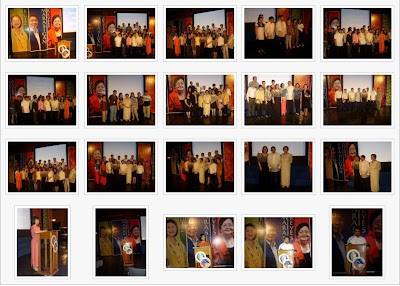

 Click on the link below to see larger images:
http://www.facebook.com/album.php?aid=172569&id=682835049&l=4ad8969112
.
Link to blog post: http://raffysaldana.blogspot.com/2009/11/photos-conferment-rites-for-title.html


 Click on the link below to see larger images:
http://www.facebook.com/album.php?aid=172569&id=682835049&l=4ad8969112
.
Wednesday, November 18, 2009
Philippine Grid Computing Forum and Workshop 2009
 Link to blog post: http://raffysaldana.blogspot.com/2009/11/philippine-grid-computing-forum-and.html
Click on the link below to see larger images:
http://www.facebook.com/album.php?aid=172119&id=682835049&l=60d361da27

PHILIPPINE GRID COMPUTING FORUM AND WORKSHOP 2009
November 17 - 18, 2009
Advanced Science and Technology Institute
Diliman, Quezon City
.
Subscribe to:
Posts (Atom)


 Posts
Posts

